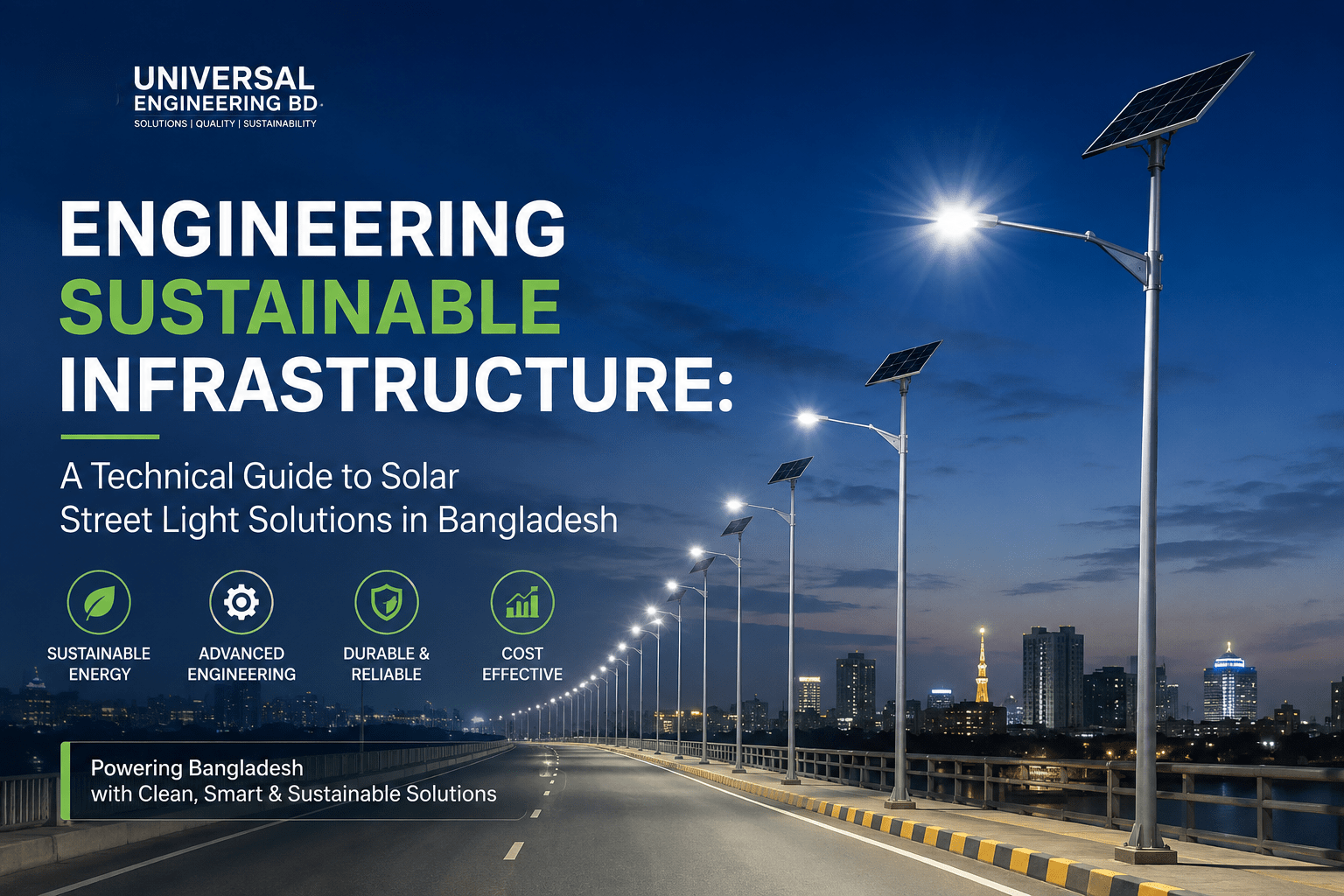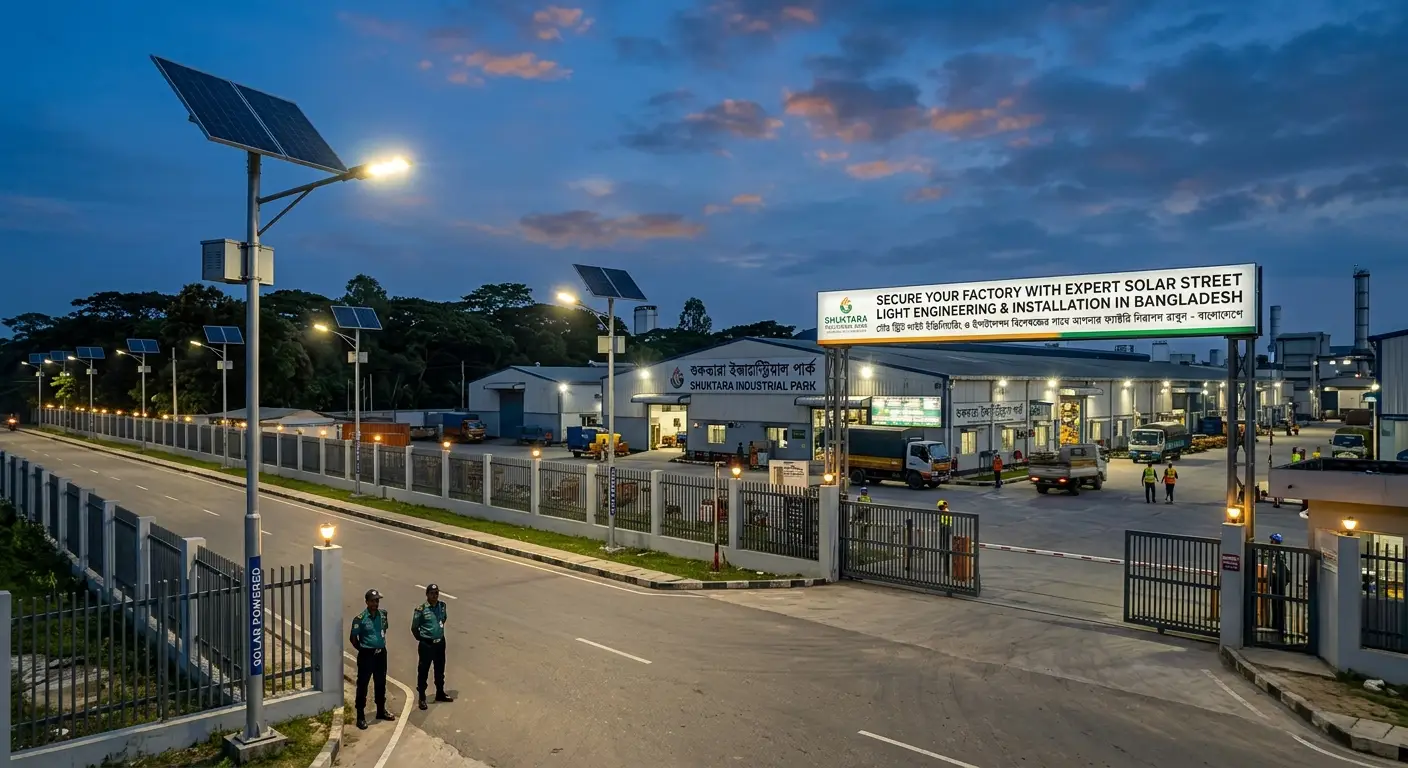
As commercial complexes expand, industrial zones develop, and rural road networks connect across the country, building resilient outdoor infrastructure has become a priority. Adopting a reliable solar street light in Bangladesh offers an off-grid alternative that reduces grid dependency, eliminates monthly power bills, and delivers uninterrupted illumination during load shedding.
Navigating Solar Street Light Solutions in Bangladesh involves evaluating varied technical configurations, battery chemistries, and structural requirements. Selecting quality components ensures that off-grid installations perform consistently across Bangladesh’s distinct tropical climate.
Understanding solar street light prices in Bangladesh requires more than comparing the initial hardware cost. A proper technical evaluation should consider the quality of key components, system efficiency, expected operational lifespan, lighting performance, and long-term maintenance requirements.
A well-engineered solar street lighting system can deliver better reliability, improved energy efficiency, and lower lifecycle costs over time.
Monocrystalline Solar PV Panel
↓
MPPT Solar Charge Controller
↓
LiFePO4 Battery Storage
↓
High-Efficiency LED Lighting Module
↓
PIR Motion & Intelligent Lighting Control
| Factor | Technical Consideration | Impact on Cost & Performance |
|---|---|---|
| 1. Battery Chemistry | LiFePO4 vs. traditional Lead-Acid | Determines cycle life, reliability, charging efficiency, and replacement frequency |
| 2. System Architecture | All-in-One vs. Split-Type Configuration | Influences installation, maintenance, thermal management, and system flexibility |
| 3. Weather Protection | IP65 / IP67-rated die-cast aluminium housing | Protects critical components from rain, dust, humidity, and harsh outdoor conditions |
| 4. Solar Charging Technology | Intelligent MPPT controller | Improves solar energy harvesting and charging efficiency under changing weather conditions |
| 5. Motion Detection | PIR-based intelligent control | Reduces unnecessary power consumption by adjusting light output based on movement |
| 6. LED Efficiency | High-lumen, energy-efficient LED module | Directly affects illumination quality, coverage area, and energy consumption |
| 7. Solar Panel Quality | High-efficiency monocrystalline PV technology | Determines daily energy generation and overall system performance |
| 8. Thermal Management | Efficient heat dissipation and durable housing | Helps maintain LED performance and extend component lifespan |
The actual value of a solar street light should therefore be assessed through total lifecycle performance—not simply the purchase price. Higher-quality components may increase the initial investment but can significantly improve durability, energy efficiency, reliability, and long-term operating economics.
For projects in Bangladesh, factors such as high humidity, monsoon rainfall, dust exposure, temperature variation, solar irradiation, and road usage patterns should be considered when selecting the appropriate system specification.
All-in-One Solar Street Lights: Integrates the photovoltaic panel, high-lumen LED chips, lithium battery pack, and MPPT controller into a single housing. This compact setup reduces civil groundwork, cable routing, and installation labor expenses.
Split Solar Street Systems: Features physically separate panels, battery boxes, and LED fixtures. While requiring additional mounting hardware and pole support, split systems accommodate larger solar arrays and higher battery capacities needed for wider highways and industrial perimeters.
The energy storage system represents a significant part of system hardware investment. Traditional lead-acid batteries degrade quickly under extreme ambient heat. Premium installations rely on Lithium Iron Phosphate ($\text{LiFePO}_4$) batteries, which offer:
Over 2,000–3,000 charge-discharge cycles (3 to 5+ years of daily service).
Superior thermal stability suited for hot summer conditions.
High charging efficiency, even during partial daylight.
Bangladesh experiences heavy seasonal rainfall, high humidity, and coastal atmospheric salinity, making environmental sealing essential:
IP65 or IP67 Sealing: Prevents water jet intrusion, moisture accumulation, and dust buildup inside sensitive electrical enclosures.
Die-Cast Aluminum Alloy: Acts as an integrated heat sink to prevent LED chip overheating while providing corrosion resistance against harsh weather exposure.
Implementing engineered Solar Street Light Solutions in Bangladesh provides financial and practical benefits:
Zero Utility Expenses: Off-grid systems run entirely on captured solar energy after commissioning.
Rapid Payback Period: Eliminating continuous power draw yields a typical investment payback within 24 to 36 months.
Continuous Security Lighting: Automated dusk-to-dawn sensors ensure perimeters remain lit during grid blackouts and storm disruptions.
Low Maintenance Requirements: Smart controllers paired with PIR motion sensors automatically adjust discharge levels, preserving battery reserve during extended cloudy spells.
Proper system sizing, structural pole engineering, and professional installation are essential for long-term reliability.
Working with an experienced engineering firm like Universal Engineering BD ensures complete project execution across Bangladesh:
Site Audits & Solar Sizing: Evaluating lux requirements, module wattages, and battery storage capacities aligned with local weather patterns.
Custom Pole Fabrication: Structural galvanized poles designed to withstand high wind speeds and severe weather conditions.
Certified Hardware Sourcing: Utilizing BUET/IDCOL standard tested panels, high-output LED modules, and $\text{LiFePO}_4$ battery systems.
Turnkey EPC Services: Managing civil foundations, pole mounting, system commissioning, and ongoing technical support.
Q1: How do solar street lights handle consecutive rainy days during the monsoon season?
A: Professionally engineered systems incorporate 2 to 3 days of autonomy (backup storage) alongside PIR motion sensors that dim light output during inactive hours, maintaining essential coverage through overcast periods.
Q2: Why is LiFePO4 chemistry preferred for solar street lighting in tropical regions?
A: Lithium Iron Phosphate ($\text{LiFePO}_4$) handles high ambient operating temperatures effectively, offers deep discharge efficiency, and lasts significantly longer than conventional lead-acid or standard lithium-ion alternatives.
Q3: What is the expected service life of an all-in-one solar street light?
A: High-grade solar panels carry a service life of 20 to 25 years, LED light engines operate for 50,000+ hours, and $\text{LiFePO}_4$ battery packs provide 3 to 7 years of continuous service before requiring simple modular replacement.