As Bangladesh continues to develop its roads, residential areas, industrial zones, commercial spaces, and public infrastructure, the demand for reliable and energy-efficient outdoor lighting is growing rapidly. Solar street lighting offers a practical solution by combining renewable solar energy with efficient LED technology.
Universal Engineering BD provides solar street light solutions designed for a wide range of applications across Bangladesh. From standalone solar LED street lights to supporting components such as solar charge controllers and street light poles, the company focuses on providing practical and dependable solutions for modern outdoor lighting requirements.
This guide explains how solar street lights work, what determines their quality and performance, and how to select the right solution for a project.
A solar street light is a standalone outdoor lighting system that uses solar energy to illuminate roads and surrounding areas after sunset.
A typical system includes:
During the day, the solar panel generates electricity and charges the battery. After sunset, the stored energy powers the LED light automatically.
This makes solar street lighting particularly useful in areas where grid electricity is unavailable, unreliable, or expensive to extend.
Bangladesh receives substantial solar energy throughout the year, making solar-powered lighting suitable for many outdoor applications.
Solar street lighting can provide several important benefits.
Solar street lights generate their own electricity from sunlight. This reduces dependence on conventional electrical infrastructure and can be especially useful for remote roads, rural areas, industrial sites, and large properties.
Modern LED lighting requires comparatively low power while providing effective illumination. When combined with solar energy, the system can reduce dependence on conventional electricity for outdoor lighting.
Because standalone solar lights do not require conventional power cables for operation, they can be installed in locations where extending grid infrastructure is difficult.
Solar energy is renewable, and combining solar power with efficient LED lighting supports more sustainable infrastructure development.
Universal Engineering BD offers solar lighting products and supporting electrical equipment for different project requirements.
Its available solar lighting range includes products under the UniLux and Green Social ranges, with different power capacities for different applications. Current product listings also show supporting solar charge controllers and street-light poles supplied by Universal Engineering.
For example, the UniLux 20W Solar LED Street Light is listed with a high-efficiency SMD LED, aluminum body, automatic on/off operation, IP65 protection, motion sensing, and a stated 50,000-hour lamp life.
The Green Social range includes higher-capacity configurations as well. A listed Green Social 36W model features a high-pressure die-cast aluminum body, IP65 protection, a 30Ah battery, and energy-saving operating modes.
These specifications demonstrate why solar street lights should be evaluated based on the complete system rather than LED wattage alone.
The performance of a solar street light depends on how effectively its major components work together.
The solar panel is responsible for converting sunlight into electrical energy.
Important factors include:
A properly sized solar panel should generate enough energy to recharge the battery according to the system’s daily energy requirements.
The LED fixture determines how effectively stored energy is converted into useful illumination.
Important specifications include:
A higher wattage does not automatically mean better lighting. Proper optical design and installation height are equally important.
The battery stores energy generated during daylight hours for use at night.
Battery quality directly affects:
The appropriate battery capacity depends on LED power, operating hours, solar availability, and required autonomy.
The charge controller manages energy between the solar panel, battery, and lighting load.
Universal Engineering also supplies solar charge controllers, including MPPT and PWM-based options. A listed MPPT 12/24V solar street light charge controller is designed for solar street-light applications and provides functions such as charging management and load control.
The pole supports the solar panel and lighting fixture and must withstand environmental conditions.
Pole selection should consider:
Universal Engineering’s listed product range includes 8-meter square and octagonal street-light poles for infrastructure applications.
Several factors influence the performance of a solar street light system.
The system needs sufficient solar energy during the day to recharge the battery. Seasonal weather, cloud cover, rainfall, and shading can affect solar generation.
An appropriately sized battery helps maintain nighttime operation and provides energy storage for periods of reduced solar generation.
Efficient LED technology allows the system to produce effective illumination while reducing energy demand.
Modern solar street lights can use different operating modes to optimize energy consumption. For example, lighting output can be adjusted during different periods of the night.
Some available Green Social models from Universal Engineering include multiple energy-saving operating periods.
The solar street light price in Bangladesh varies according to system specifications and project requirements.
Important price factors include:
For example, current online listings associated with Universal Engineering show different price points across UniLux and Green Social solar street light models. These should be treated as product-listing prices rather than universal project pricing because specifications and installation requirements can vary.
For a proper project, buyers should compare total system value and lifecycle cost, rather than choosing a product based only on the lowest initial price.
Universal Engineering BD’s solar lighting solutions can be considered for a variety of outdoor applications.
Solar street lights can provide illumination in rural areas where grid infrastructure may be limited.
Housing developments and residential communities can use solar lighting for internal roads, walkways, entrances, and common areas.
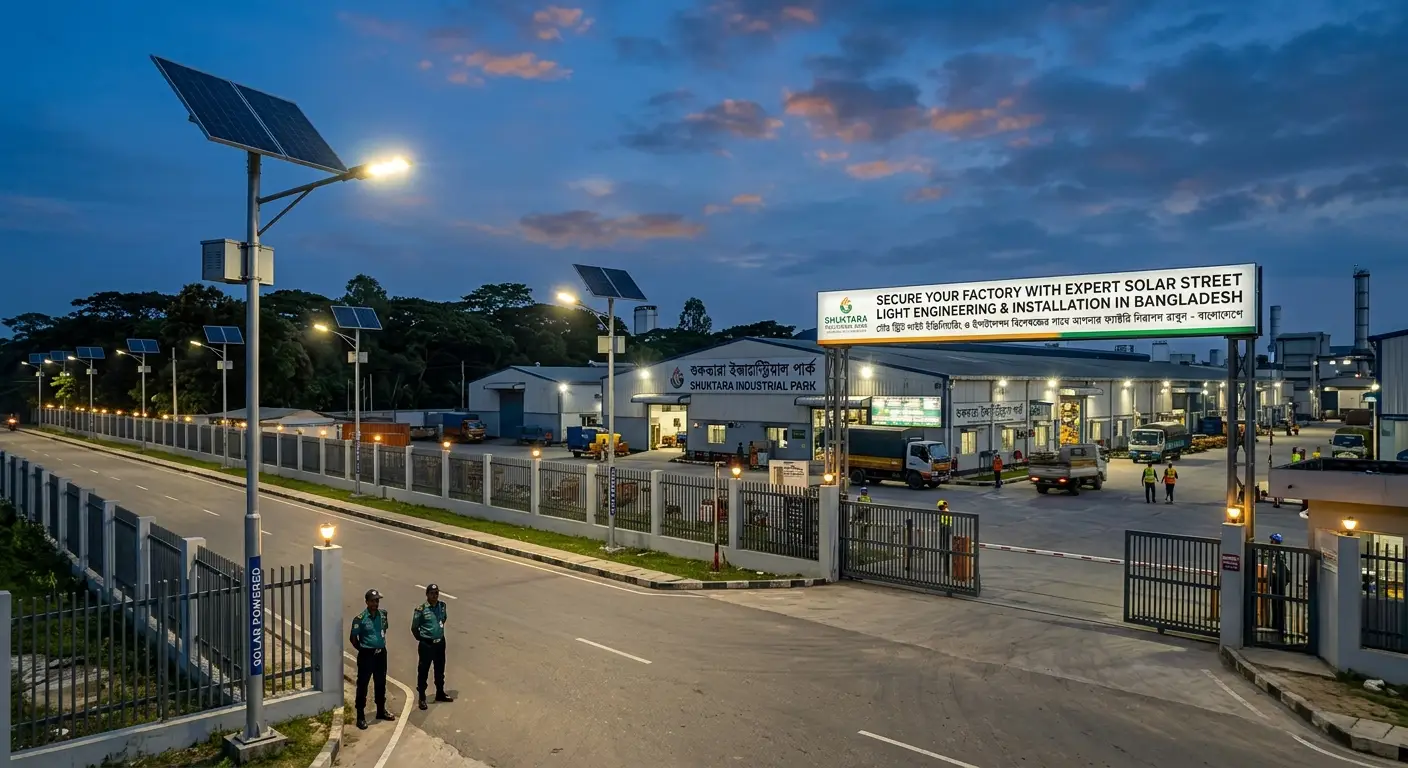
Factories and industrial properties can use solar street lighting around:
Shopping areas, offices, warehouses, and commercial compounds can benefit from independent outdoor lighting.
Solar lighting can also be suitable for parks, pathways, community spaces, and other outdoor public areas.
Selecting a solar street light should begin with the project requirements.
Evaluate the road width, available sunlight, surrounding structures, environmental conditions, and required pole positions.
Consider the required brightness, coverage, operating hours, and desired lighting uniformity.
Choose the LED power and optical distribution based on the actual application rather than simply selecting the highest wattage.
Battery capacity should be matched to the lighting load and required operating duration.
The solar panel should provide adequate energy generation for the expected daily consumption and battery charging requirements.
Pole height, structural strength, wind resistance, foundation design, and corrosion protection should be considered.
A reliable supplier should be able to provide:
A solar street light is a long-term infrastructure investment.
Choosing a low-cost product without considering component quality can create additional costs through:
For this reason, buyers should evaluate the entire system before making a purchasing decision.
Solar street lights generally require limited routine maintenance, but regular inspection can help maintain performance.
Recommended maintenance activities include:
Proper maintenance can help extend the useful operating life of the system.
When selecting a solar street light supplier in Bangladesh, product availability is only one consideration. Technical support and the ability to provide appropriate components are also important.
Universal Engineering’s current listed product range includes solar LED street lights, solar charge controllers, batteries and street-light poles, allowing customers to consider multiple components of a solar lighting system from one supplier.
The company can therefore be considered for projects requiring solar street lighting equipment and related electrical components.
Operating duration depends on battery capacity, LED power, solar charging conditions, lighting schedule, and system design. Different models therefore provide different operating times.
Solar street lights can be used in Bangladesh’s rainy climate, but equipment should have appropriate outdoor protection and be correctly installed. Product specifications such as IP rating should be checked before purchase.
The major factors include solar panel capacity, battery type and capacity, LED power, controller technology, pole specifications, installation requirements, and overall system quality.
Yes. Standalone solar street lights are designed to generate and store their own electrical energy and therefore do not require a conventional grid connection for normal operation.
There is no single best model for every application. The appropriate system depends on road dimensions, lighting requirements, operating hours, solar availability, pole height, battery capacity, and project budget.
Solar street lighting is becoming an important solution for sustainable outdoor infrastructure in Bangladesh. However, successful implementation depends on choosing the right combination of solar panels, batteries, LED fixtures, controllers, poles, and installation methods.
Universal Engineering BD provides a range of solar street lighting products and related components designed for different outdoor lighting requirements. By focusing on quality, appropriate system sizing, reliable components, and long-term performance, organizations can make better decisions for residential, commercial, industrial, rural, and infrastructure projects.
If you are planning a solar street lighting project in Bangladesh, the right approach is to evaluate the complete system—not just the price or wattage of the light.