
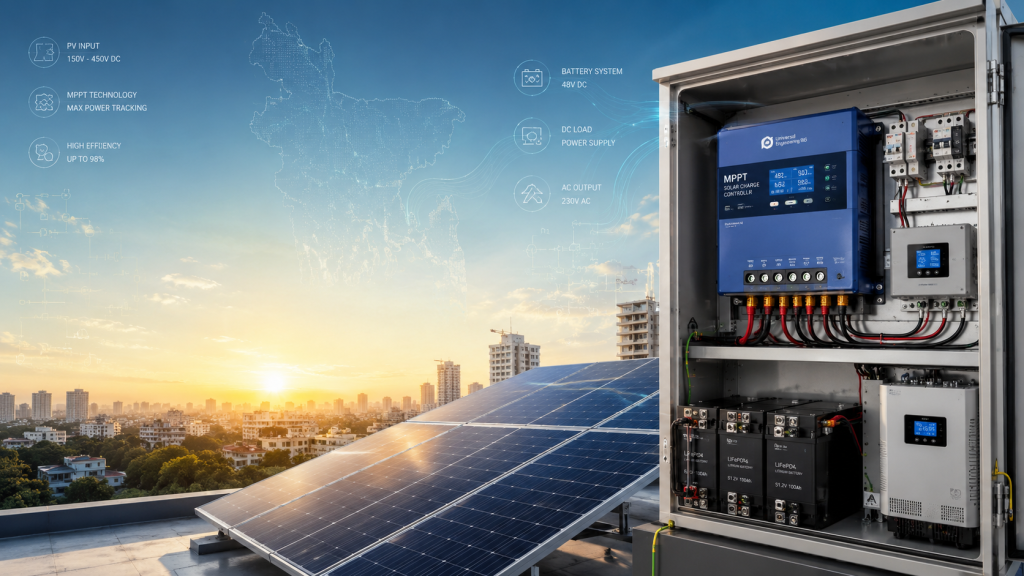
As solar energy adoption sweeps across Bangladesh—from suburban rooftop installations to off-grid industrial backup systems—investing in high-quality system components is vital. While solar panels capture sunlight and batteries store electricity, theSolar Charge Controller in Bangladesh acts as the digital brain and safety safeguard of any off-grid or hybrid solar installation.
Without a reliable charge controller, expensive battery banks can suffer from overcharging, deep discharge, or premature thermal breakdown—significantly reducing their operational lifespan.
In this comprehensive selection and engineering guide, Universal Engineering BD breaks down everything you need to know about choosing, sizing, and implementing the right solar charge controller for your property in Bangladesh.
A sontolar charge croller regulates the voltage and current flowing from the solar PV array directly to the battery bank. Its primary function is to keep batteries fully charged without allowing overcharging during peak sunlight hours or reverse current leakage back into the panels during the night.
Overcharge Protection: Automatically throttles or stops energy flow when battery capacity reaches 100%.
Deep Discharge Protection: Disconnects loads when battery voltage drops below critical limits, preventing permanent chemical damage.
Reverse Current Blocking: Prevents stored energy in the battery from leaking back into the solar panels during night hours.
Voltage Regulation: Smooths out fluctuating solar array output to provide stable charging profiles (Bulk, Absorption, and Float states).
When selecting a charge Solar Charge Controller in Bangladesh, the decision comes down to two primary technologies: Pulse Width Modulation (PWM) and Maximum Power Point Tracking (MPPT).
| Feature | PWM Charge Controller | MPPT Charge Controller |
| Efficiency | ~70% – 80% | 95% – 99% |
| Voltage Matching | Requires PV voltage to match battery voltage closely. | Converts excess PV voltage into additional charging current. |
| Monsoon Performance | Poor efficiency under cloudy or overcast weather. | High performance; extracts maximum power in dim light. |
| System Scale | Ideal for small, budget-friendly setups (under 300W). | Ideal for medium-to-large residential & industrial setups. |
| Cost | Low initial investment. | Higher upfront cost, but yields faster ROI through energy gain. |
In Bangladesh, solar systems must perform through fluctuating weather conditions—from high summer heat to prolonged overcast monsoon rain.
Monsoon Irradiance Capture: MPPT (Maximum Power Point Tracking) controllers continuously monitor and recalculate the panel array’s V-I characteristic curve, extracting up to 30% more power during low-light cloudy days compared to older PWM models.
Temperature Compensation: Solar panel output voltage drops as temperatures rise in hot tropical summers. High-grade MPPT units adjust charging parameters dynamically based on real-time ambient temperature sensor inputs.
Sizing a charge controller correctly requires calculating array wattage, operational voltage, and safety margins. Universal Engineering BD applies strict engineering standards to ensure zero system bottlenecking.
To find the required amperage rating for an MPPT controller, use the basic power formula:
Note: The 1.25 (25%) safety margin accounts for momentary irradiance spikes, bright overcast reflections, and cold morning peak surges.
Solar Array: $1,200\text{ W}$ total PV capacity.
Battery Bank: $24\text{ V}$ DC setup.
Formula: $(1200\text{ W} / 24\text{ V}) \times 1.25 = 50\text{ A} \times 1.25 = 62.5\text{ A}$
Engineering Recommendation: Select a 60A or 80A MPPT Charge Controller to comfortably handle load spikes without thermal throttling.
Ensure the total open-circuit voltage ($V_{oc}$) of your solar panel string (especially in series setups) does not exceed the controller’s maximum allowable DC voltage limit, taking local temperature variations into consideration.
Modern solar energy setups in Bangladesh are shifting rapidly from traditional flooded lead-acid and gel batteries to Lithium Iron Phosphate (LiFePO4) technology.
Customizable Charge Profiles: A proper solar charge controller must support programmable lithium charge parameters (Bulk Voltage, Float Cutoff, and Low-Voltage Disconnect).
BMS Synchronization: Advanced MPPT controllers from Universal Engineering BD support RS485/CAN communication protocols to talk directly with the battery’s internal Battery Management System (BMS), ensuring precise multi-stage charging and safety.
Selecting the right charge controller involves more than reading spec sheets—it requires careful system balance and precision safety engineering. Universal Engineering BD provides full-service solar engineering solutions across Bangladesh:
Certified Tier-1 Equipment: Sourcing heavy-duty MPPT controllers with built-in surge, short-circuit, over-temperature, and reverse-polarity protections.
Custom System Integration: Designing balanced systems across residential setups, commercial properties, and remote off-grid telecom or agricultural facilities.
Local Technical Support: Professional installation, system commissioning, warranty support, and long-term maintenance throughout Bangladesh.
The solar charge controller is a vital component that protects your battery bank investment and maximizes total daily power yield. Upgrading to a properly engineered MPPT charge controller ensures high efficiency, weather resilience, and continuous power delivery.
Looking for the right solar charge controller for your home or enterprise?
Contact Universal Engineering BD today for technical guidance, system sizing, and high-performance solar solutions tailored for Bangladesh.
🌐 Website: universalengbd.com