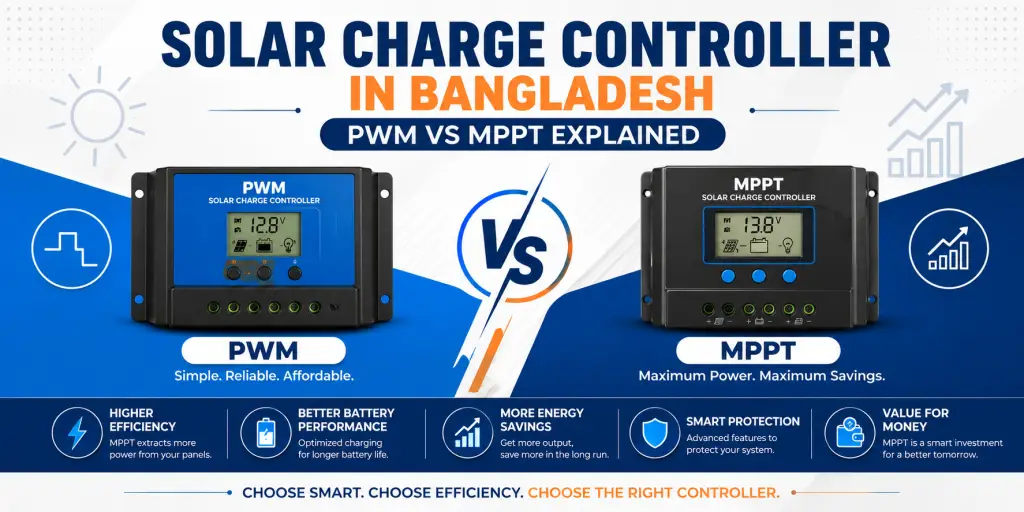
As solar energy adoption continues to grow across Bangladesh, choosing the right solar charge controller has become more important than ever. Whether you are setting up a home solar system, an irrigation project, or a commercial backup solution, the charge controller plays a vital role in protecting your batteries and improving system efficiency.
In this guide, we’ll explain the differences between PWM and MPPT solar charge controllers, their advantages and disadvantages, and help you choose the best option for your solar power system.
What is a Solar Charge Controller and Why Do You Need One?
A solar charge controller is an essential device placed between the solar panel and the battery bank. Its primary job is to regulate voltage and current coming from the solar panels to prevent battery overcharging or deep discharge.
Without a charge controller, batteries can become damaged, overheat, or lose lifespan quickly.
Key Functions of a Solar Charge Controller
- Protects batteries from overcharging
- Prevents reverse current flow at night
- Improves battery lifespan
- Optimizes charging performance
- Ensures stable power delivery
For solar systems in Bangladesh’s varying weather conditions, a quality controller is critical for long-term reliability.
PWM Solar Charge Controller
PWM stands for Pulse Width Modulation. It is the traditional and more affordable type of solar charge controller.
How PWM Controllers Work
A PWM controller gradually reduces the amount of power sent to the battery as it approaches full charge. It directly connects the solar panel to the battery using rapid switching technology.
This method works best when the solar panel voltage closely matches the battery voltage.
Advantages of PWM Controllers
- Lower cost
- Simple and reliable technology
- Ideal for small solar systems
- Easy installation and maintenance
- Suitable for basic home lighting systems
Disadvantages of PWM Controllers
- Lower efficiency compared to MPPT
- Wastes excess panel voltage
- Less effective during cloudy weather
- Not ideal for large solar installations
MPPT Solar Charge Controller
MPPT stands for Maximum Power Point Tracking. It is a more advanced and highly efficient solar charging technology.
How MPPT Controllers Work
MPPT controllers continuously track the maximum power point of the solar panel and convert excess voltage into additional charging current.
This allows the system to harvest significantly more energy from the solar panels.
Advantages of MPPT Controllers
- Higher efficiency (up to 30% more efficient)
- Faster battery charging
- Better performance in cloudy conditions
- Supports higher voltage solar panels
- Ideal for large residential and commercial systems
Disadvantages of MPPT Controllers
- Higher initial cost
- More complex technology
- Requires professional installation in some systems
PWM vs MPPT – Side-by-Side Comparison
| Feature |
PWM Controller |
MPPT Controller |
| Technology |
Basic |
Advanced |
| Efficiency |
Lower |
Higher |
| Cost |
Affordable |
Expensive |
| Charging Speed |
Moderate |
Fast |
| Best For |
Small systems |
Large systems |
| Performance in Cloudy Weather |
Average |
Excellent |
| Battery Compatibility |
Limited |
Wider compatibility |
| Solar Panel Voltage Flexibility |
Low |
High |
Which Solar Charge Controller is Best for Bangladesh?
The right controller depends on your budget and system size.
Choose PWM If:
- You have a small home solar setup
- Budget is your top priority
- Your system operates in stable sunlight conditions
Choose MPPT If:
- You need maximum energy efficiency
- You are installing a large solar power system
- Your location experiences variable sunlight
- You want better long-term savings
For most modern solar projects in Bangladesh, MPPT controllers are becoming the preferred choice due to improved performance and energy savings.
Universal Engineering BD Product Recommendations
Universal Engineering BD offers a wide range of high-quality solar charge controllers suitable for residential, commercial, and industrial applications.
Recommended PWM Controllers
- 10A PWM Solar Charge Controller
- 20A PWM Battery Charging Controller
- LED Display PWM Controller
Recommended MPPT Controllers
- 30A MPPT Solar Charge Controller
- Smart MPPT Controller with LCD Display
- Industrial Grade MPPT Solar Regulator
These products are designed for Bangladesh’s climate and power conditions, ensuring reliable solar performance year-round.
Final Thoughts
Choosing the correct solar charge controller can significantly impact your solar system’s performance, battery lifespan, and energy savings.
If you need a budget-friendly solution for a small setup, PWM controllers are a practical choice. However, for maximum efficiency and long-term value, MPPT controllers are the better investment.
As solar energy demand grows in Bangladesh, investing in quality solar components will help ensure dependable and sustainable power for years to come.