As Bangladesh continues its rapid journey toward becoming a middle-income nation, the demand for efficient, cost-effective, and sustainable infrastructure has never been higher. One of the most visible shifts in this transformation is the move toward Solar street lighting in Bangladesh. From the bustling highways of Dhaka to the quiet paths of rural villages, solar technology is proving to be the most viable solution for the country’s unique energy landscape.
Universal Engineering BD, we are committed to leading this change by providing high-performance solar lighting systems tailored specifically for the Bangladeshi environment.
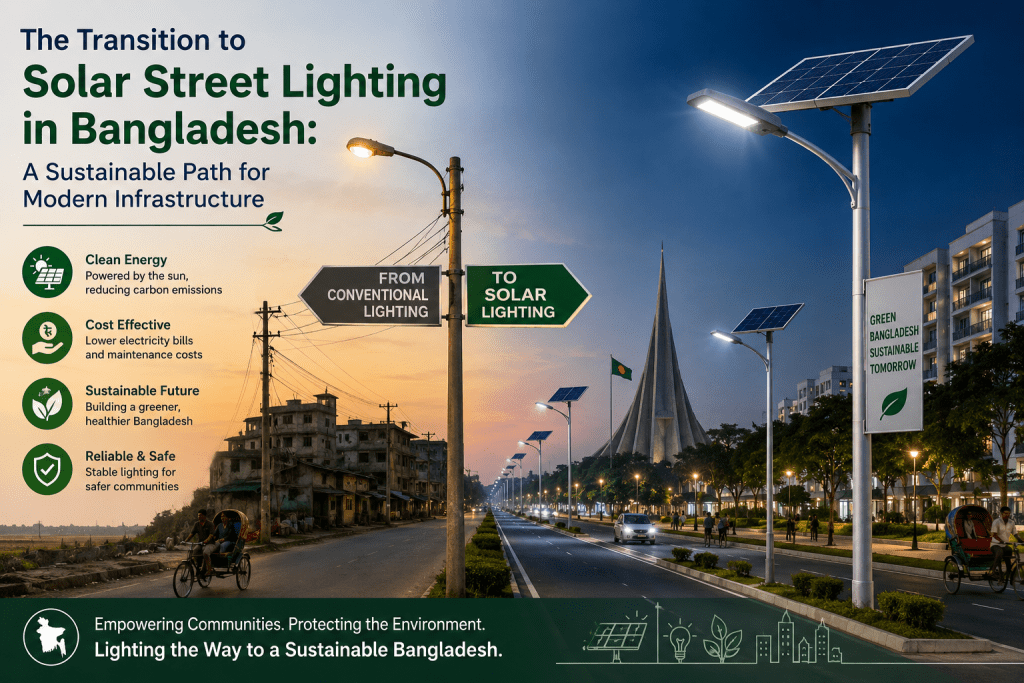
For decades, street lighting in Bangladesh relied heavily on the national power grid. However, as urbanization spreads and the need for rural connectivity grows, traditional grid-connected lighting faces several challenges:
Solar Street Lights bypass these hurdles entirely. They are decentralized power plants on a pole—capturing energy during the day and providing light at night without costing a single taka in electricity bills.
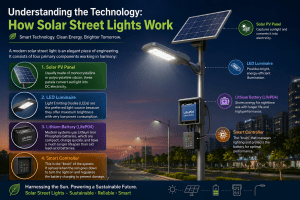
A modern solar street light is an elegant piece of engineering. It consists of four primary components working in harmony:
At Universal Engineering BD, we recognize that a residential street in a housing society has different needs than a high-speed national highway. We offer three distinct categories of lighting solutions:
The All-in-One system is the pinnacle of modern design. The panel, battery, controller, and LED are all housed in a single, sleek casing.
In this configuration, the solar panel is mounted separately at the top of the pole, while the light and battery are positioned lower.
These systems are connected to both the solar panel and the national grid.
When considering the solar street light price in Bangladesh, it is important to look at the Total Cost of Ownership (TCO) rather than just the initial purchase price.
While a solar light may cost more upfront than a traditional bulb and a wire, the savings begin on day one:
In most commercial and government projects in Bangladesh, a solar street light pays for itself through energy savings alone within 2 to 3 years.
In many parts of rural Bangladesh, street lighting is a luxury. Solar lights provide safety for women and children at night, allow markets to stay open later, and help reduce crime in areas where the police cannot easily patrol.
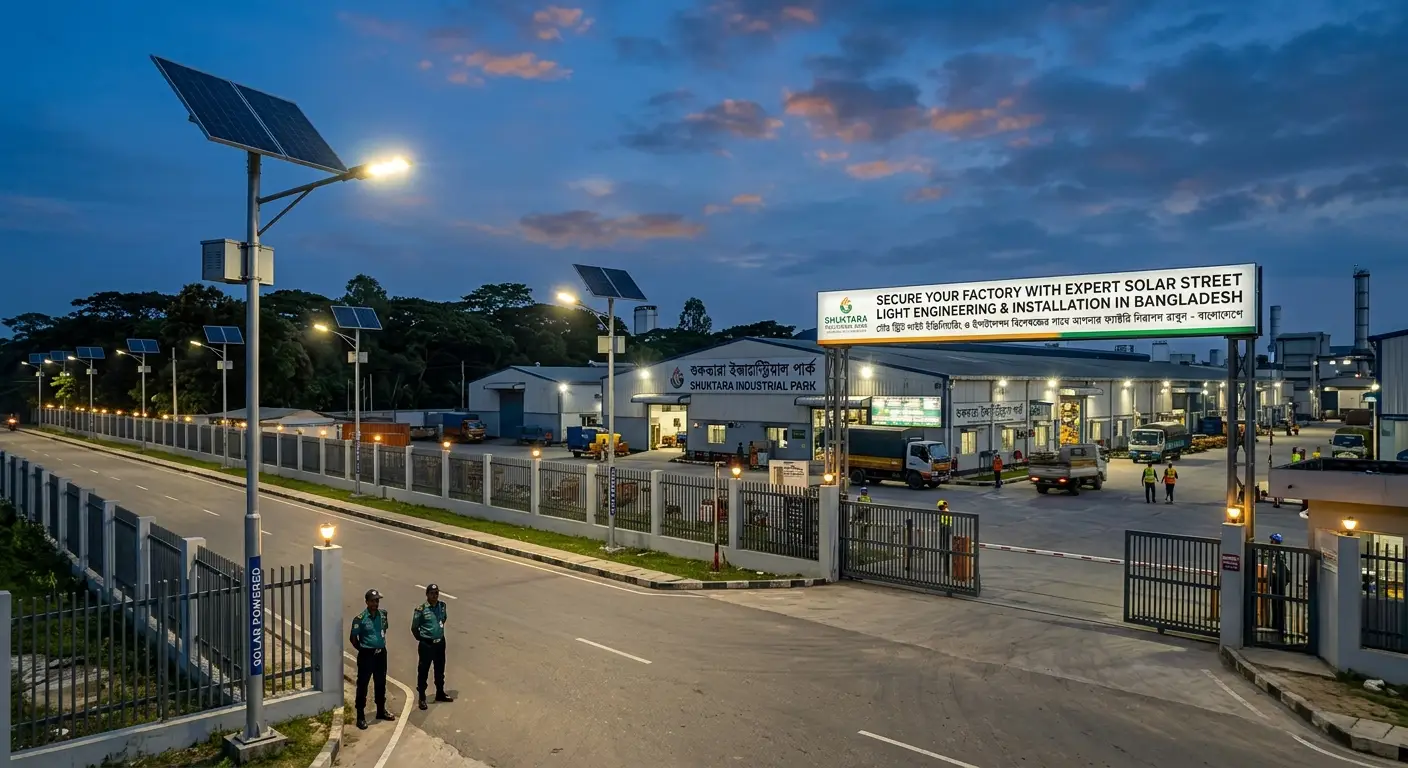
Factories and warehouses often have large perimeters that require constant lighting for security. Solar lights provide an independent security layer—if the main factory power goes out, the perimeter lights stay on.
Modern housing societies in Dhaka and Chittagong are branding themselves as “Green” and “Eco-Friendly.” Installing solar street lights increases property value and reduces the service charge for residents.
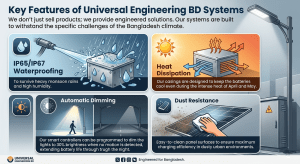
We don’t just sell products; we provide engineered solutions. Our systems are built to withstand the specific challenges of the Bangladesh climate:
While solar lights are “low maintenance,” they are not “no maintenance.” To get the most out of your investment:
The future of outdoor lighting in Bangladesh is undeniably solar. As the country moves toward its “Vision 2041” goals, transitioning to renewable energy is no longer just an environmental choice—it is an economic necessity.
Whether you are a project manager for a government initiative, a factory owner, or a community leader, Universal Engineering BD has the expertise to help you transition to clean, reliable, and free lighting.
Contact Universal Engineering BD today for a site assessment and a customized quote for your solar street lighting project.
Yes. Our systems are designed with “autonomy,” meaning the battery holds enough charge to power the light for 2-3 nights even if there is heavy cloud cover during the day.
We use high-quality LifePO4 (Lithium) batteries that typically last between 5 to 7 years depending on usage and heat conditions.
Not at all. For All-in-One systems, you simply mount the light onto a pole and tighten the bolts. No electrical wiring or technicians are required for the connection.
Our All-in-One units are installed high on poles with specialized mounting hardware, making unauthorized removal very difficult.
We provide local technical support, genuine warranties, and components that are tested for the specific voltage and weather conditions of Bangladesh. Cheap alternatives often fail within 6 months due to poor battery quality.